

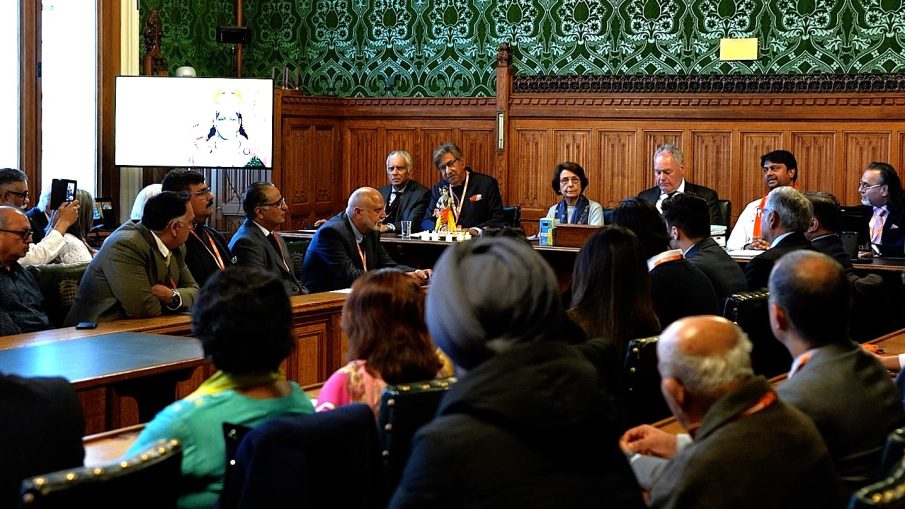
Anil Bhanot speech on the aspirations for Ram-Rajya
Ram Naumi celebration for us at Hindu Council UK is to remind ourselves Lord Ram’s mode of governance, the Ram-Rajya, his rule of law, applicable equally to all. We are grateful to Shri Bob Blackman for allowing us to host the Ram Naumi celebrations in this HoC’s committee room. Lord Ram was born on the 9th day of Chaitra, the first month in the Indian calendar and the number 9 to us represents completeness and fulfilment.
Lord Ram from his very young age lived only for others. First, he was taken by Rishi Vishwamitra to protect Sadhu’s puja mandals in the jungles which some wicked people used to desecrate. Then to save his father’s honour he chose to take a 14-year exile to go and live in the jungles. His wife, Sita, loved him so much she too went with him. Rishi Valmiki who composed the original Ramayana describes their deep love for each other when they lived in the jungle. We witness this true love as Lord Ram left no stone unturned to rescue Sita from the clutches of a demonic king Ravan.
It’s worth remembering, however, that after defeating Ravan, what should have been a celebratory event for Lord Ram, it was one full of remorse for Lord Ram because of the loss of life that the battle brought. Whilst the victory of good over evil was necessary, nonetheless he felt remorse for the lives killed in the battle, including of Ravan of who was learned on one hand but on the wrong side of Dharma on the other. Thus, at Rameshwarm by the ocean, he prayed to Lord Shiva for atonement. Humane acts like these are what earned him the title: Maryada-Purshottam, the ideal man, a perfect compassionate person. Rameshwarm boasts now a 1200 pillar temple on the site of that puja.
Rishi Valmiki lived in Ram’s time and so his Ramayana is the original history, the Itihaas of India. But during the last century many scholars found some contradictory interpolations in the last chapter of Valmiki Ramayana, the Uttarkand chapter. These interpolations probably came about because Ramyana story was carried orally for millennia, and post Valmiki some writers inserted their own verses in the last chapter which are not even of a Valmiki type of ancient Sanskrit, their poetry style is different. However, we are lucky that a 16th century saint Tulsidas ji wrote his version of Ramayana, the Ramchritmanas, which did away with those contradictions and had omitted them entirely, and that 4 centuries before the critique of interpolations by scholars. Tulsidas ji, it would seem had a divine connection with Lord Ram and there are several accounts of his meeting Hanuman ji also, not to mention the miracle on the 40th day of his imprisonment by Mughal king Akbar when the king was forced to release him free. Indeed, some say Sant Tulsidas ji is Valmiki reincarnated.
I’d like to take the opportunity here to mention that Rishi Valmiki in his youth was known to have a Shudra vocation in our varnashrama system of 4 categories of vocations, who later changed his vocation to spiritual learnings and came to be known as a Brahm-Rishi, revered by all including by King Ram and Queen Sita. This fact alone shows the dignity of labour of a Shudra, in the ancient Varnashram system, and a fluid system where he could change vocations to become a Brahm-Rishi, a revered Saint.
Ram and Sita ruled happily long together in Ayodhya and here we learn also Ram’s respect for women generally and but especially for Sita, when he says: Siye Chadhai, Chadhe Raghu Rai, meaning Sita is always above him and that is why we say SiyaRam and not RamSiya. In the Hindu tradition women are accorded a higher status of respect than men.
As a king, Ram held open courts of all people, not just closed raj courts, so that he could learn about people’s problems first hand. In fact, he told his subjects that he too is accountable to the rule of law: So Mohi Barjihu, Bhaye Bisrahi, which means he is telling the people to hold him accountable also. Furthermore, it shows that the law is not just left to the king and his ministers to interpret but the public can offer their interpretation also, so it’s a two way thing in Ram-Rajya.
Ram-Rajya means that the rule of law applies not just equally to everyone, but everyone has the right to challenge its inadequacies. British parliament has been at the forefront of creating such equality laws, and transparent structures to debate the best laws but I am afraid some of us now feel excluded from that process. It seems our voice no longer matters. Our debates are frowned upon, as is my personal experience. When I entered into a debate to find solutions through dialogue and legislation on the problem of our Hindus being attacked but the Government Legal Department, no less, wrote back to me to simply shut me down. When they were pointed out on their mal-interpretation of some quasi-laws they invoked their ‘qualified-privilege’ to shut down the debate. So, it’s become hard for us to speak when we are attacked like on our Holi festival in Harrow and attacks on our community in Wembley earlier this month. We are basically being discarded as 2nd class citizens. Whereas only a decade ago we used to be respected as equals, in fact all faiths used to work together to find community solutions but now community policies without our input are being imposed on us. We seem to be going backwards.
For instance, Ram Mandir Peterborough is presently undergoing some adverse designs by the Peterborough council. It reminds us of Ram Mandir Ayodhya which took us 500 years to make right a wrong, and now we are faced with a similar situation here in the UK. We hope Lord Ram will give the right wisdom to the Peterborough Council politicians. They should observe the equality laws of this country, and above all try and be ‘inclusive’ to all the British communities.
Let us finish on a Mantra for the Ram-Rajya aspirations for transparency and equality. The governments need to take courage to do the righteous things for the long term and not be swayed by the short-term power politics, and the right thing only comes through a transparent and an inclusive debate. It may be hard at first but it’s the only way to be fair to everyone. Here’s the Mantra to Lord Ram for his Ram-Rajya wisdom for us all:
“Om Ram Rameti Rameti Rame Rame Manormay; Sahaseranaam Tatatulayam Ramnaam Vraananay”
Anil Bhanot
Ram Naumi Event 26 March 2026 @HoC’s
PS. Jagadguru Rambhadracharya ji, who gave evidence at the Court to help conclude the Ram Janam Bhoomi legal decision in favour of Ram Mandir at Ayodhya, validates in this video clip below the wrong interpolations inserted in the Valmiki Ramayana’s Uttarkhand chapter, specifically saying that Ram & Sita never separated after their return to Ayodhya. Here is the clip:
[Hindu Council UK is a national umbrella body representing one million British Hindus through their temples and cultural organisations, estd. 1994]